
›› News and Views ››
Education and Employment Products..: R.S. Mooshahary
Official
website of Govt. of Assam – Public Information Officers (Union Govt.)
– Public Information Officers (Indian Parliament) – Central Information
Commission (CIC) – Directorate of Information & Public Relations
Govt. Of Assam
RTI
Acts & Rules – RTI User’s Guide
– RTI Acts 2005, FAQ (in Assamese)
– RTI Acts 2005, Main Characteristics
(in Assamese)
Education and Employment Products without Prospects
By: R.S. Mooshahary
The Assam labour minister informed the State Assembly in its last session that there were 10,58,247 educated unemployed
registered with the employment exchanges in the State. This included 1,128 engineers, 385 doctors, 425 agriculture graduates,
129 veterinary graduates, 11,482 postgraduates in arts, science and commerce and 2,08,384 graduates. The actual number of
unemployed youth in the State will be more than this as many of them do not register with the employment exchanges, which does
not really help them get jobs. However, to an extent it reveals the grim aspect of youth energy remaining idle which otherwise
should have become an asset for the State.
Doctors are in short supply in the rural areas where they do not want to work. So in their case it is their preference to work
in the urban area which would have made them register with the employment exchanges. The others who are qualified engineers,
veterinary or agriculture graduates have failed to find opportunities to use their learning. The State cannot employ all of
them, nor is there any industry or organization to utilize their skill. The rest, which forms more than 98 per cent, are
unemployable because they have no skill.
The India Labour Report 2007 says that Indian youth are simply unemployable. Failure in quality education and skills, lack of
technical and vocational training and policy blunders make it imperative for structural change in our system of education,
says the report. Ninety per cent of employment opportunities require vocational skills, but 90 per cent of our college and
school output has only bookish knowledge, according to the study commissioned by the Team Lease Services, a human resource and
staffing agency.
Of the many objectives of education, the one that aims at equipping the students with the art and skills of self-reliance and
usability is perhaps the most important. Without it, it is devoid of direction and not worth pursuing. In fact, education without
skill is worse than no education at all. An uneducated person is willing to work in the field as wage earner, sharecropper or anything.
But our education makes a person misfit for such type of work. They are a greater social liability and their large presence is as
potentially dangerous as the tinderbox in the midst of withered forest that can spark off a conflagration any time.
Our universities and colleges are mass production units of degree holders. It does not seem to be the concern of the education system
to empower the youth with the skills for employment and self-help. The problem has another dimension. The college admission season is
a nightmare for the students and parents alike. Admission in any college is difficult without good marks, which more than half the
students do not obtain. They have no avenue to pursue higher studies except through private coaching. In other words, the State is not
in a position to provide quality education to the growing number of students and there is a scramble even for such education in
absence of any other choice for the better. This is an irony of the system, which is deficient in both extent and content.
A few weeks back, I had an opportunity to attend a function organized by a private IT college in the city. There, over 2,500 students
are pursuing diploma and degree courses in subjects like business administration, computer application, information technology,
journalism, bioinformatics, telecom technology, etc. There are no cut-off marks for admission and the students profile indicate they
are those who fail to secure admission in reputed institutions within the State or cannot afford to go outside to pursue further
studies. Fees structure is higher than government institutions but affordable, and the college has offered fee free-ship also to a few
very poor students.
While the standard of its teaching may not be comparable with that of the institutions like the IIMs or IITs, surely it will not be
inferior to the ones in government-run colleges. It cannot be better, given the quality of students it admits. Nevertheless, the
college has been doing a commendable job in providing some employable skill to the young people who could not have otherwise dreamt
of acquiring it. Where will these young men, who cannot secure admission in good colleges, go? Their first hurdle is not getting
job but acquiring skill for the job, and there is not enough of this opportunity.
The average and mediocre students from poor and lower middle-class background who form over 90 per cent of the student force face these
problems of skill deprivation. They feel inadequate to face the competitive world and soon develop cynical attitude. Slowly they lose
faith in social and human values and drift to the life of crime and violence. They are also most vulnerable to exploitation that breeds
conflict and corruption in the society.
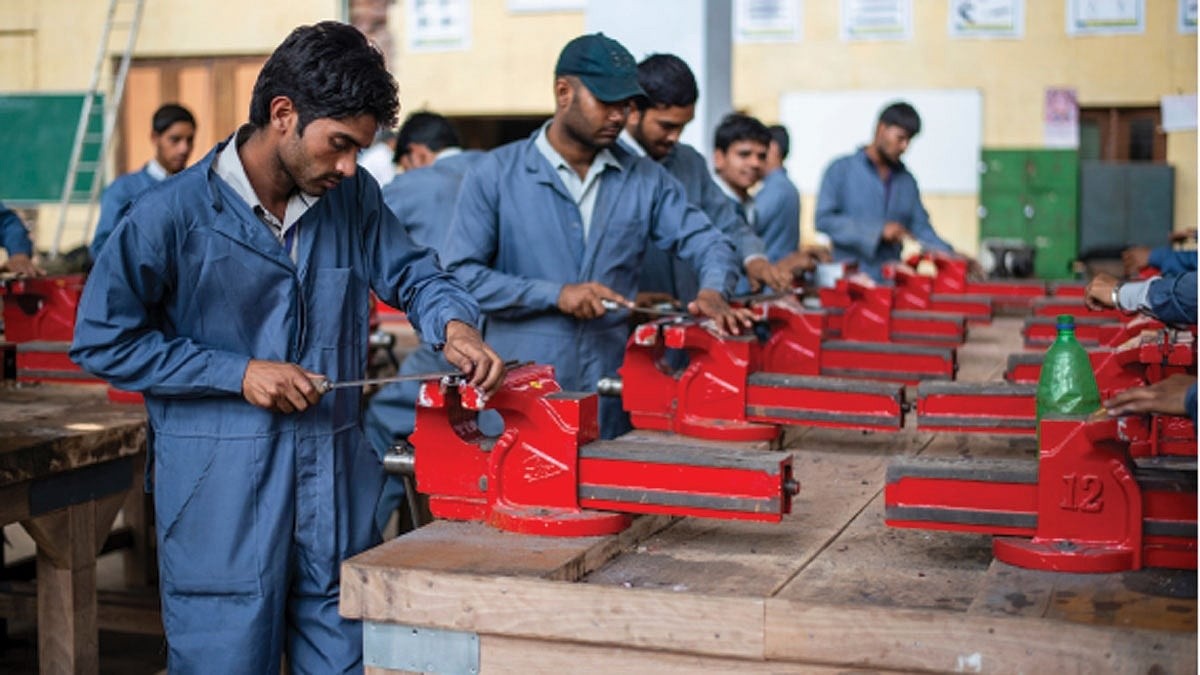
Any skill-related education is better than the plain arts/science degree colleges that only add to the growing list of the unemployable
crowd. The Industrial Training Institutes established by the governments have not been able to relate to the changing needs in skill
inculcation, though they provide some technical skills to the students that help them engage themselves in some vocation and blue-collar
jobs.
Another worrisome fact is the low level of employability of our professionals. For example, despite Indian IT professionals being in
high demand in the world market, only about 30 per cent of them are actually employable in the IT sector. Likewise, only 25 per cent of
engineering graduates, 15 per cent of finance and accounting professionals, and 10 per cent of professionals with any kind of degree
are suitable for employment in global organizations. With more and more multinationals wanting to set up shops in India, the gap
between demand and supply for the IT professional alone is estimated at 5,00,000 in the next three years, and the demand for other
professionals will be much higher in the coming years. We have thus the problem of inadequacies � of jobs and of the professionals to
fit the bill in a highly knowledge-based world.
It is a paradoxical situation. In the base of the education pyramid, there are already some 200 million youth seeking jobs while the
professionals with requisite skills will always be short of demand in the years to come. We need more institutions for training high
professionals but, more importantly, we need to create a class of skilled workforce, which is socially more important than the elite
class institutions. We need more of institutions that inculcate technical skills without ignoring humanities and arts subjects. There
must not be restriction in the selection and combination of subjects for learning.
The policy should be to encourage acquiring skill in a broad-based pursuit of knowledge so that our youth develop human values alongside
their professional expertise. This way alone we can remove the mismatch between education and employment and help build a self-reliant
and healthy youth.
The State has a major responsibility in promoting quality education. It has to act on the paradigm that enabling private players in
knowledge dissemination is the only way to expand its reach and add value to its content. It has to reconcile with the inevitability of
its role-change � from that of all-powerful regulator to benign facilitator and not cling to the power of a predator to feed on the
private entrepreneurs on selective criterion of cash-for-consideration approach.
Society cannot thrive if its youth become parasites through faulty educational practices, if they become devoid of values in their
frustration and cynicism, and if they cannot engage in productive enterprises.
(The writer is Chief Information Commissioner, Asom)
Copyright, 2005-2006. All rights reserved.
Hosting, Designed and Maintained by AMTRON, Guwahati