
News and Views ›› Poverty and Hunger The Grameen …: R.S. Mooshahary
Official
website of Govt. of Assam – Public Information Officers (Union Govt.)
– Public Information Officers (Indian Parliament) – Central Information
Commission (CIC) – Directorate of Information & Public Relations
Govt. Of Assam
RTI
Acts & Rules – RTI User’s Guide
– RTI Acts 2005, FAQ (in Assamese)
– RTI Acts 2005, Main Characteristics
(in Assamese)
Poverty and Hunger The Grameen Ways of Alleviation
By: R.S. Mooshahary
No one is poor by choice or design. Poverty is an inherited curse. Of course, some people become poor through profligacy,
stupidity or greed. While not all the poor are hungry, all the hungry are poor and abjectly so. Hunger is an extreme
deprivation that takes away the spirit and dignity of man enslaving his soul in the perdition of suffering.
The International Food Policy Research Institute�s Global Hunger Index has put India in the 94th position out of 118 countries.
Even Ethiopia manages hunger better than India and it ranks a notch above us at 93. Pakistan too ranks ahead of us at 88 and
China is far ahead at 47. The UNFAO in the State of Food Insecurity World Report 2006 finds the largest number of undernourished
people in the globe in India. In its earlier report in 2004, it had shown that India had added more people to the
��newly hungry�� in the planet than the rest of the world put together.
The other aspects are that India�s economy is buoyant with over 9% growth rate. The country is awash with money � India has
the fifth largest forex reserve at $ 267 billion, an Indian has reportedly become the richest person in the world, the sensex
is zooming to new heights and consumerism is visibly extensive. NSSO surveys show that people not getting enough to eat all
round or part of the year have fallen from 15% of the population in 1983 to 5% in rural areas and 1.9 % in urban areas in
1994-95 and to just 2.6% in rural and 0.6% in urban areas in 2004-05.
These statistical indicators are of no use to the hungry, nor does the rising per capita income or the falling rate of
inflation hold any substance for them � the shrunken, emaciated children of lesser gods who do not know where the next meal
will come from. Their struggle is for survival � for food, shelter and health care. We have them everywhere � in the slums,
streets, railway stations, towns and cities. At a very conservative count they may be anywhere between 2 to 3% of the
population � 20 to 30 million hungry people who exceed the total population of Australia.
The disparity between poverty and prosperity provides a fertile soil for class conflict. Today out of 600 districts in the country,
the Maoist violence has spread to 157 districts. Our poverty alleviation programmes � there are legions of them � have not made a
difference among the poorest in the society. Even Bangladesh has managed the population and hunger much better. Since it became
independent in 1971, its population has nearly doubled but the country has managed its food shortage creditably. It is close to food
sufficiency despite its population density nearly three times ours.
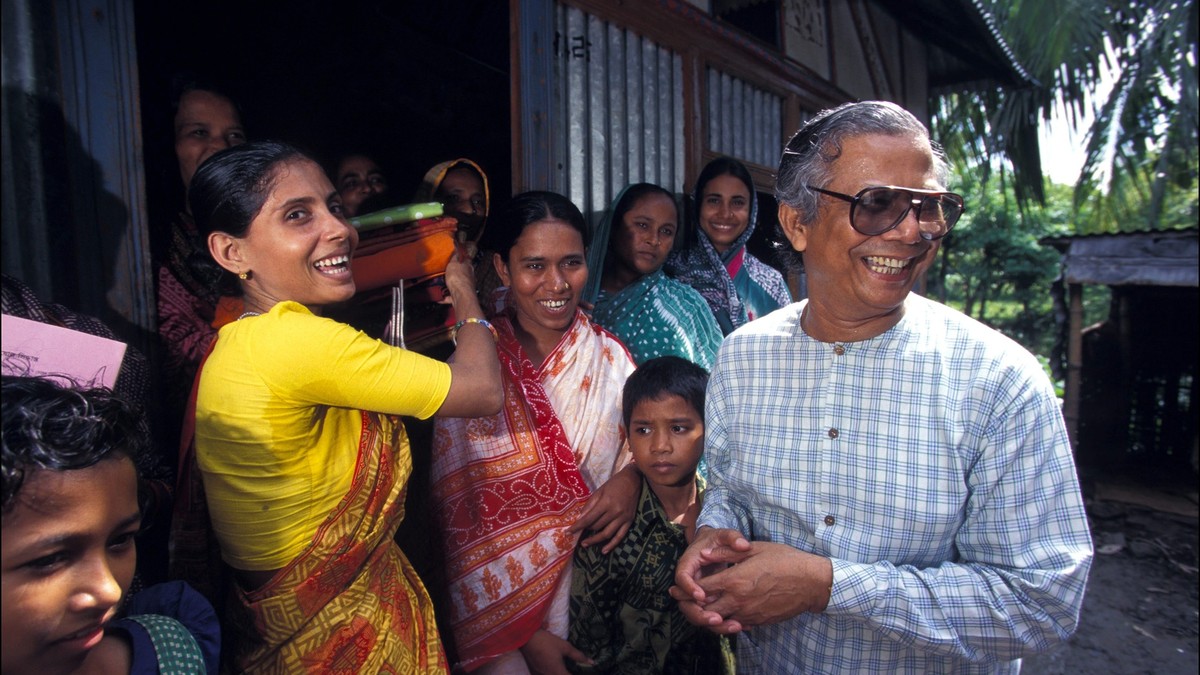
Muhammad Yunus, the winner of the 2006 Nobel Peace Prize, is a Bangladeshi. His book Banker to the Poor � The Story of the Grameen
Bank is an engrossing catalogue of poverty and religious orthodoxy in his country and the struggle and suffering that he faced along
the way in his endeavour to make a change in their lives. It provides the hands-on approach to uplift the lowest-rung of the deprived
ladder through empowering the women in a country with strong religious and social bias against women. It is a miracle that he
succeeded and made it a thriving entrepreneurial pursuit to create a new awakening among the millions of underprivileged citizens. It
has proved that freedom from poverty also implies freedom from social slavery.
Women who had never experienced handling any money, who could not read or write, who had never communicated with other men than their
immediate family members; women enslaved by tradition, poverty and exploitation � all became his clients and improved their miserable lot.
By using micro-credits, they could feed the family, build shelter over their heads, send children to schools and provide them with health
care and food security � all that sound like the fairy tales, but it has happened and it is happening.
The Grameen movement began in 1976 with Yunus providing the first loan of 856 takas � $ 27� from his pocket to 42 destitute women.
Amid resistance and opposition by vested interest groups, the disbursements reached the first one billion dollar in 18 years. Its
benefits so encouraged the poor that the next one billion dollar was disbursed in just 27 months in 1998 and it reached to 2.3 million
borrowers in 38,551 villages. Small is both beautiful and bountiful. The smallest loan given by Grameen was 30 takas or 75 US cents to
a woman. In 22 years, its loan disbursements exceeded the total amount of rural loans disbursed by all other banks in Bangladesh. Now
it is disbursing billions of dollars every year through its extended schemes like Grameen phones, housing, retirement, health care etc
apart from banking services, and it is replicated all over the world � not only in the third world but also in the developed countries
because there too exist pockets of poverty.
Grameen targets 25% of the extremely poor of whom 98% are women. They do not come to the bank. The bank goes to the poor, stays with
them, persuades them to take loans without guarantee or collateral, and guides them what to with it. The repayment schedules are
spread on weekly basis depending on the income generated by the loan. There is almost cent per cent repayment which proves that the
poorest is much more creditworthy than well-to-dos. It also demonstrates that women have better accountability in financial management.
Muhammad Yunus has really proved that so much can be done for so many by so few who are committed to a cause. He is personally rich
but committed to mitigate the tyranny of hunger and the impact of poverty on humanity. He works for the poor, lives with them and
stands by them.
The poor of Yunus are not marginally poor but abjectly poor like the beggars, weavers, pushcart operators, daily wage earners,
rickshaw peddlers and the jobless who are born hungry and who die in the prison of hunger. They do not have the capital to invest in
the tools that generate income; for them life is a hell on earth. Their children too follow the same cycle of wretched existence. They
are the left-outs of our poverty alleviation schemes.
We spend huge amounts in the forms of doles, grants and subsidies, which do not improve their lot. It is like giving alms to the
beggar with a sense of sympathy without realizing that by doing so you are only helping to perpetuate his hopeless existence. As the
Chinese adage goes if you give a fish to a person he will eat it once, but if you teach him how to fish he will eat it lifetime. We
need to empower the needy to help themselves with dignity and hope.
Let our banks � the rural credit-oriented banks in particular � train and motivate their staff to work with missionary zeal for the
poorest and let the banks go to them offering micro-credits with which they can generate income according to their own ability.
Economists and planners can create wealth but they cannot remove human destitution resulting from lack of commitment to the poorest.
It has to be done at micro-level.
Poverty and hunger are the worst form of human disaster. We need to reach out to them as we do to the victims of natural disasters.
More importantly, we need to reach them with our hearts and empathy as Yunus and his team is doing.
(The writer is Chief Information Commissioner, Asom)
Copyright, 2005-2006. All rights reserved.
Hosting, Designed and Maintained by AMTRON, Guwahati